
Most B2B growth strategies are built on a fragile foundation of technical debt and data silos that collapse long before they reach the £10M ARR milestone. This failure often stems from an outdated B2B go to market framework that cannot support modern scale. You've likely felt the friction of marketing and sales teams operating in separate universes, powered by a fragmented tech stack that consumes more budget than it generates. The traditional approach of hiring a full-time executive at a massive premium to solve unproven strategies is no longer a viable path to scale. It's too slow. It's too expensive.
You recognise that efficiency is the only lever that matters in a high-stakes market. This guide delivers the definitive architectural blueprint for 2026, engineered to eliminate operational drag and replace it with a unified revenue engine. We're moving beyond simple checklists. You'll learn how to master a high-velocity system that leverages AI-driven operations and strategic fractional leadership to hit eight figures. We're providing a clear roadmap to £10M ARR, detailing how to automate marketing workflows and align your entire organisation under a single, aggressive growth architecture. Precision execution starts here.
Key Takeaways
- Shift from static "launch-and-leave" tactics to a continuous revenue architecture designed for sustained, high-velocity expansion.
- Deploy a modern B2B go to market framework that prioritises behavioural ICP modelling to establish absolute category authority.
- Purge hidden technical debt from your outbound infrastructure by positioning Marketing Ops and AI agents as your central nervous system.
- Transition from passive lead capture to aggressive demand generation using a modular execution roadmap engineered for the £10M ARR milestone.
- Leverage fractional CMO leadership to secure elite strategic oversight while avoiding the £200k+ overhead of traditional executive hires.
The Evolution of the B2B Go-To-Market Framework for 2026
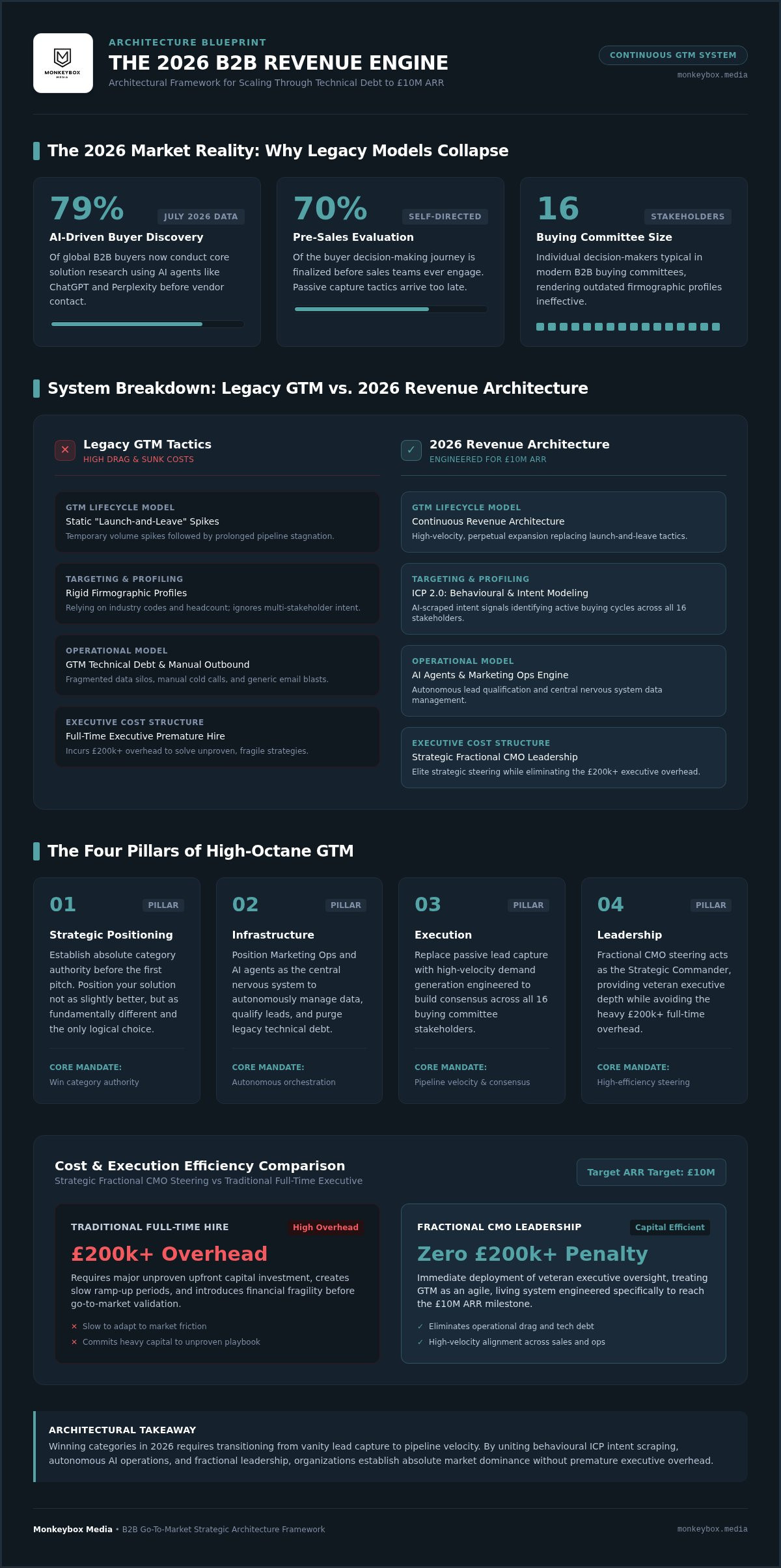
By 2026, the concept of a "product launch" has become a relic of a slower era. Today, a successful B2B go to market framework isn't a single event; it's a continuous revenue architecture built for high-velocity scaling. Traditional "launch-and-leave" tactics create temporary spikes followed by stagnation. We build engines that accelerate. The focus has shifted from the vanity metrics of lead generation to the hard reality of customer generation and pipeline velocity. You don't need more leads; you need more revenue, faster. This requires a Strategic Commander at the helm, someone who views GTM as a living system rather than a static checklist.
Why Traditional GTM Frameworks Fail in the AI Era
Manual-heavy outreach models are obsolete. With 79% of global B2B buyers using AI-driven tools like ChatGPT and Perplexity to research solutions as of July 2026, the window to influence the buyer journey has shifted. Buyers are often 70% through their decision-making process before they ever speak to your sales team. If your GTM relies on cold calling and generic email blasts, you're already behind. GTM technical debt is the silent killer of growth, defined as the accumulation of fragmented data silos and inefficient manual processes that prevent your revenue engine from scaling. Relying on legacy systems in a high-velocity market is a recipe for irrelevance.
The Four Pillars of High-Octane GTM Strategy
To engineer a £10M ARR engine, your B2B go to market framework must stand on four unbreakable pillars. This structure ensures that every component of your organisation is aligned toward a single, aggressive objective.
- Strategic Positioning: Winning your category isn't about being slightly better; it's about being fundamentally different. You must establish absolute category authority before the first pitch, making your solution the only logical choice for your ICP.
- Infrastructure: Your Marketing Ops and AI agents are the central nervous system of the business. This isn't just a tech stack; it's an automated engine that handles the heavy lifting of lead qualification, data management, and campaign execution autonomously.
- Execution: High-velocity demand generation replaces passive lead capture. Every interaction is engineered to build consensus among the 16 decision-makers now typical in B2B buying committees.
- Leadership: Fractional CMOs provide the executive-level steering needed to navigate complex markets. This model offers the strategic depth of a seasoned veteran without the £200k+ overhead of a full-time hire.
Execution is where strategy meets reality. By integrating these pillars, you create a modular system that is easy to scan, simple to scale, and impossible for competitors to ignore. We aren't just launching products; we're constructing the infrastructure for market dominance.
Strategic Foundations: Defining Your Category and Ideal Customer Profile (ICP)
Firmographic profiles are dead. They don't account for the 16 decision-makers now standard in enterprise committees. A robust B2B go to market framework leverages behavioural modelling to identify high-intent accounts before they even hit your site. You need to know who's looking, what they're reading, and why they're stalling. This isn't just data collection; it's strategic intelligence. Understanding What is GTM? in 2026 means aligning your brand promise with technical product reality to prevent churn before it starts. Category authority is the prerequisite for market dominance. If you don't define the space, your competitors will.
The ICP 2.0: Behavioural and Intent-Based Targeting
Precision targeting requires more than just industry codes and headcount. We use AI agents to scrape intent signals across the digital ecosystem, identifying accounts currently in a buying cycle. This allows you to prioritise accounts based on revenue potential and expansion fit rather than geographical convenience. Mapping the buyer committee is essential. You aren't selling to a person; you're navigating a complex web of stakeholders. By isolating the specific pain points of each committee member, you build consensus early. High-velocity scaling depends on this level of granular foresight. It's about being in the right room before the door even opens.
Brand Positioning as a Growth Lever
Service providers compete on price. Bold Architects own the category. To reach £10M ARR, your narrative must justify premium pricing and high-value retainers by positioning your solution as the only logical choice. This is where strategic urgency comes into play. You don't just solve a problem; you mitigate a critical risk. We develop positioning that forces prospects to realise the cost of inaction. It's a shift from "nice to have" to "mission-critical." If your brand doesn't project elite performance, you'll stay trapped in the commodity basement. Establishing an architectural GTM strategy ensures your positioning is backed by a scalable revenue engine that actually delivers on its promises.
Execution requires a unified vision. When your brand positioning aligns with your behavioural ICP, you eliminate friction in the sales cycle. You stop chasing leads and start engineering customers. This foundation is the bedrock of a £10M engine. It's direct, it's efficient, and it's designed for total market capture.
The Revenue Engine: Integrating Marketing Operations and AI Agents
Marketing operations is no longer a back-office support function. It is the central nervous system of a modern B2B go to market framework. If your data doesn't move at the speed of your market, your revenue engine will stall. We view Marketing Ops as the structural integrity of your growth. It requires a "Revenue Operations" mindset that unifies sales and marketing data into a single, aggressive source of truth. This alignment ensures that the 16 decision-makers typical in today's buying committees receive a consistent, high-impact narrative. Data silos are the enemy of scale. We eliminate them.
Eliminating Technical Debt in Marketing Automation
Most organisations are suffocating under the weight of bloated tech stacks. These redundant tools create friction in the buyer journey, leading to missed signals and lost opportunities. To ensure £10M ARR scalability, you must audit your outbound infrastructure to purge "Hidden Technical Debt." This debt manifests as broken integrations, duplicate records, and manual workarounds that drain your team's energy. Standardising your data flows is the only way to maintain high-velocity momentum. Automation debt is the primary blocker to GTM velocity. A lean, engineered stack is your most potent competitive advantage.
Deploying AI Agents for Scalable Outreach and Ops
Execution in 2026 demands more than simple macros or basic automation. We're deploying autonomous AI agents to handle high-frequency, low-value strategic tasks. These agents operate as active participants in your workflow, managing lead scoring and personalised content distribution at a scale no human team can match. By July 2026, 96% of marketers had adopted AI tools; however, the real winners are those moving from simple analytics to agentic execution. These systems reduce headcount costs while exponentially increasing your strategic output. This isn't just efficiency. It's a fundamental re-engineering of how B2B companies go to market. You don't need a larger team; you need a more intelligent engine.
This integration turns your marketing infrastructure from a cost centre into a high-octane revenue generator. By automating the mechanics of execution, your leadership can focus on high-level strategy and market positioning. The result is a unified, scalable engine ready for the £10M milestone. Precision in your operations creates the speed required for market dominance.
The Execution Roadmap: From Strategic Vision to Market Dominance
Vision without a modular execution roadmap is simply expensive overhead. We build for dominance. A high-velocity B2B go to market framework transforms strategic intent into a tangible revenue outcome by eliminating the friction between vision and value. We move beyond the era of passive lead capture. We focus on aggressive demand generation. This journey requires a structured, three-phase approach to High Growth GTM Planning, ensuring every tactical move contributes to the £10M ARR milestone. Precision is mandatory.
Phase 1: The Infrastructure Audit and Foundation Build
Purge the rot before you scale. We start by consolidating the tech stack to eliminate technical debt and standardise data flows across the entire organisation. This isn't just about tidying up; it's about structural integrity. We define the KPIs that actually correlate with revenue growth: pipeline velocity, customer acquisition cost (CAC) payback, and net revenue retention (NRR). Performance measurement must be automated from day one. We establish the baseline today to measure the explosion tomorrow. A clean foundation is the only way to support a high-octane engine.
Phase 2: Launching the High-Velocity Demand Engine
Execution begins with multi-channel playbooks designed to drive strategic urgency. We align sales enablement tools with the new GTM narrative, ensuring the message remains consistent across all 16 decision-makers involved in the modern buying committee. AI agents optimize campaign performance in real-time, adjusting bids and creative based on live intent data. This addresses the critical gap in traditional GTM planning where AI is used for analysis but ignored in autonomous execution. We bridge the gap between marketing execution and sales pipeline visibility. No more guessing. Total transparency.
Phase 3: Scaling Through Strategic Command
The final phase is about long-term market dominance. We move from tactical execution to strategic command, refining the GTM framework based on data-driven revenue insights. This prepares the organisation for the next stage of professional maturity. You aren't just hitting quarterly targets; you're owning the category. The roadmap is modular, allowing for rapid pivots without losing momentum. By 2026, video content will account for 82% of internet traffic, and your engine must be ready to scale across these high-value channels. Engineer your £10M revenue engine with Monkeybox Media.
The transition from vision to dominance is a methodical process. Each phase acts as a building block, contributing to a cohesive narrative of systematic improvement. When your execution matches your strategic ambition, the £10M ARR goal becomes an inevitability rather than a target. We provide the blueprint. You command the market.
Scaling the Framework: Why Fractional Leadership Outperforms Traditional Hires
The final component of a resilient B2B go to market framework isn't a tool or a tactic. It's leadership. High-growth firms often stall because they treat marketing as a series of tasks rather than a unified architectural system. Hiring a full-time CMO in 2026 carries massive financial risk, especially when you're still engineering your revenue engine. You're looking at a £200k+ overhead before a single campaign is even launched. Fractional leadership eliminates this bloat. It provides the elite strategic oversight of a "Bold Architect" without the long-term liability of a permanent executive hire. This model is the primary driver of a successful GTM Strategy for Tech, turning your vision into a scalable reality.
Strategic Authority vs. Tactical Execution
B2B companies need a partner, not a subordinate service provider. A Fractional CMO brings an outside perspective that is impossible to maintain from within a company silo. We identify operational waste and technical debt that internal teams often overlook because they're too close to the mechanics. Our focus is on efficiency and impact, not "fluff" or vanity metrics. We don't just manage teams; we architect the entire revenue machine. This authority ensures that your GTM framework remains agile and results-oriented. You aren't paying for a manager to watch the clock. You're paying for a commander to win the market.
This leadership model prioritises structural integrity. While traditional hires might focus on maintaining the status quo, a fractional leader is incentivised to build systems that function autonomously. We implement the AI agents and RevOps workflows discussed in previous sections to ensure your team produces at a level far beyond their headcount. It's about creating a machine that doesn't break when you double your spend. Strategic command is the difference between a £2M plateau and a £10M breakout.
The ROI of Flexible Marketing Leadership
Recruitment cycles for full-time executives can last six months or longer. In a high-velocity market, that's an eternity. A fractional hire provides immediate time-to-value. You leverage elite performance for specific growth phases, scaling up or down as the market demands. This flexibility accelerates the implementation of AI agents and automation infrastructure. You get the expertise required to navigate the £10M ARR journey without the permanent drag on your balance sheet. Next steps are simple. Integrate a Fractional CMO into your B2B go to market framework to steer your execution. Efficiency wins every time. Execution is everything.
Command Your Category: Engineering the £10M Breakthrough
Engineering a £10M ARR engine requires more than just ambition; it demands a structural shift in how you view growth. We've moved beyond the era of manual-heavy outreach and fragmented data silos. By adopting a continuous B2B go to market framework, you establish the foundation for high-velocity scaling and absolute category authority. You've seen how integrating AI agents and Marketing Ops turns your infrastructure from a cost centre into a results-driven machine. Now, the focus must shift to elite execution.
Fractional leadership provides the strategic command necessary to navigate this complexity without the burden of executive-level overhead. You don't need a larger headcount; you need a more intelligent architecture. It's time to purge the technical debt and launch your high-velocity demand engine. Precision in your leadership is the final lever for market dominance.
Architect your £10M ARR roadmap with Monkeybox Media and secure the strategic leadership, specialised AI implementation, and fractional CMO authority required to win. Your path to eight figures is a matter of engineering, not luck. Let's build it.
Frequently Asked Questions
What is a B2B go-to-market framework?
A B2B go to market framework is a comprehensive architectural blueprint for delivering a product to market and capturing demand efficiently. Unlike a simple launch plan, it functions as a continuous revenue engine. It integrates market positioning, pricing, and distribution channels with a focus on high-velocity scaling. This system ensures every stakeholder is aligned toward the £10M ARR milestone by eliminating operational drag and technical debt.
How does a GTM framework differ from a marketing strategy?
Marketing strategy focuses on long-term brand awareness and lead generation. A GTM framework is an execution-heavy roadmap that encompasses product-market fit, sales alignment, and customer success. It's the "Strategic Commander" that dictates how these functions interact to drive revenue. While marketing strategy is about the message, the GTM framework is about the entire delivery mechanism and the infrastructure required to scale it aggressively.
What are the core components of a GTM framework for SaaS?
The core components include a behavioural Ideal Customer Profile (ICP), category positioning, and a modular execution roadmap. In the SaaS sector, this must also incorporate a robust Marketing Ops foundation and automated data flows to manage complex buyer committees. Success requires a unified source of truth across the tech stack. This ensures that the 16 typical decision-makers in a buying committee receive a consistent, high-impact narrative.
How do AI agents fit into a modern B2B GTM plan?
AI agents function as active participants in the revenue engine by automating high-frequency, low-value strategic tasks. They handle autonomous lead qualification, real-time campaign optimisation, and personalised content distribution at scale. By July 2026, 96% of marketers had adopted AI tools, but elite performers use agentic AI to execute workflows rather than just analyse data. This reduces headcount costs while exponentially increasing the strategic output of your GTM operations.
Why is sales and marketing alignment critical for GTM success?
Misalignment creates data silos and fragmented buyer experiences that kill pipeline velocity. A unified revenue engine requires sales and marketing to operate under a single B2B go to market framework with shared KPIs. When these teams are aligned, they build consensus among decision-makers faster and reduce the cost of acquisition. Total visibility across the sales pipeline ensures that marketing execution directly feeds into high-value sales opportunities without friction.
What is the role of a Fractional CMO in a GTM framework?
A Fractional CMO acts as the "Bold Architect" who designs and oversees the construction of the revenue engine. They provide executive-level leadership and strategic command without the £200k+ overhead of a full-time hire. This role is responsible for identifying technical debt, refining market positioning, and implementing the automation infrastructure required for scale. They ensure the organisation maintains a results-oriented focus during critical growth phases toward £10M ARR.
How do you measure the success of a GTM execution?
Success is measured through hard revenue metrics rather than vanity lead counts. Key performance indicators include pipeline velocity, customer acquisition cost (CAC) payback, and net revenue retention (NRR). You must also track the efficiency of your automated workflows and the time-to-value for new market entries. A successful execution demonstrates a clear, data-driven path to market dominance and a scalable system that maintains structural integrity under pressure.
When should a B2B company hire a GTM strategy consultant?
You should engage a consultant when fragmented tech stacks or misaligned teams begin to stall your growth toward the £10M milestone. If your current outreach is manual-heavy or you lack executive-level strategic steering, an outside perspective is vital. A GTM strategy specialist identifies the silent killers of growth, such as technical debt, and builds the automated infrastructure needed for high-velocity expansion. Efficiency is the only priority.